
Against the Machine
No thank you: I won't do what you tell me

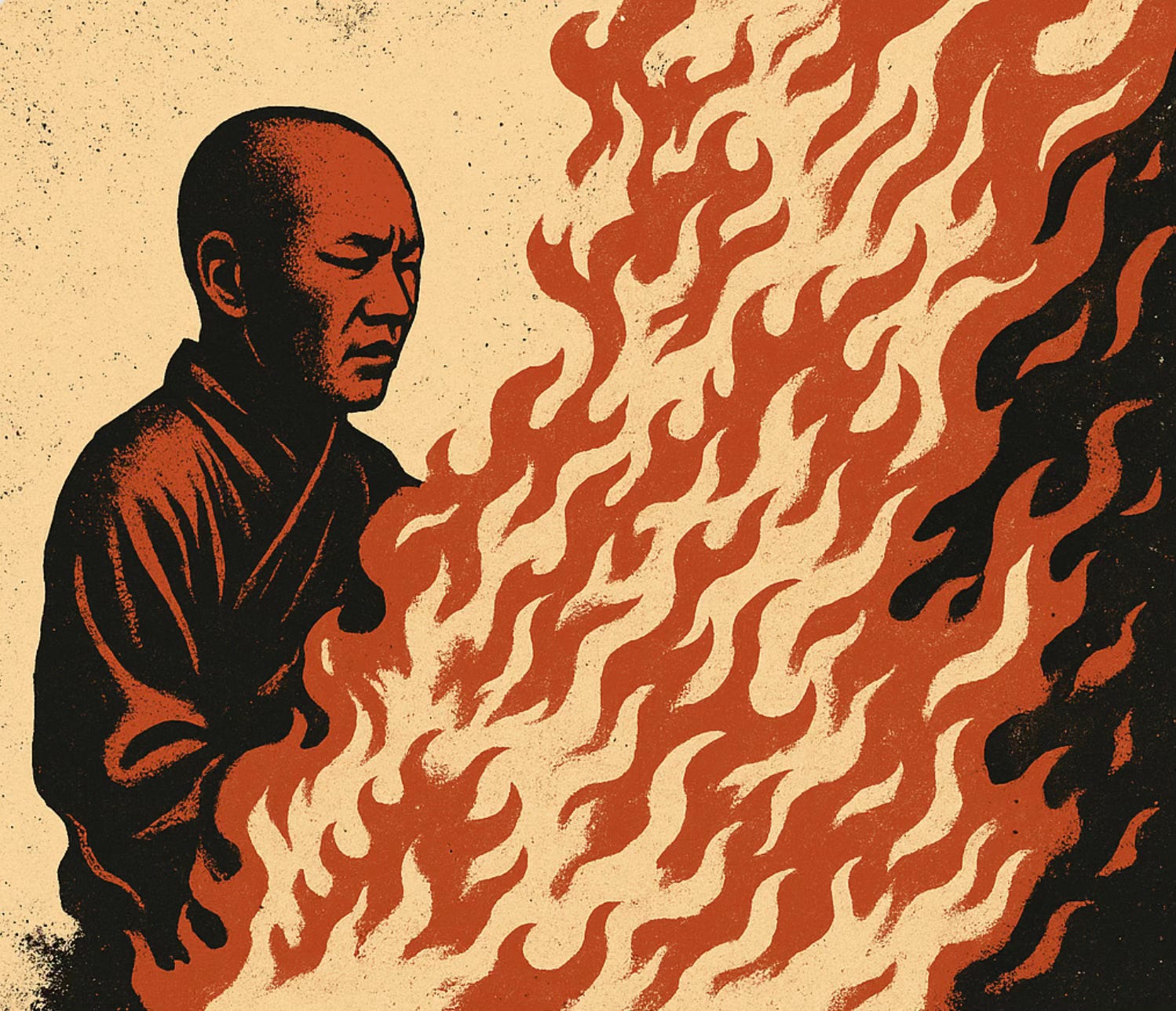
When I was thirteen, I found Rage Against the Machine’s self-titled album at the Sam Goody in the Staten Island Mall. I knew nothing about the band. But the cover—a Buddhist monk self-immolating—stopped me cold. That, and the name itself: Rage Against the Machine. It called to me.
Listening to it at home, the sheer fury of the songs felt like vindication. Then came “Killing in the Name” with its now-infamous refrain: “Fuck you, I won’t do what you tell me,” screamed sixteen times in a row.
Playing that song for friends was like sharing contraband. Most thought it was cool in a “we found dad’s Playboy stash” kind of way. But for me, it was different. It was the perfect soundtrack to everything boiling inside me. Rage at my brother for his bullying. At my dad for vanishing. At the kids who called me “Gandhi” like it was an insult.
Then over the next few years, something shifted. Girls noticed me. My friends and I became the cool kids. I went to college, aced my classes, built a career. Each time I revisited that album, it resonated less. Eventually, it became just workout music. The rage had nowhere to live anymore. If there was a machine, I’d become a well-oiled part of it.
But some kernel of that angry kid survived. Which is why, thirty years later, I couldn’t help but pick up Paul Kingsnorth’s recent surprise hit book “Against the Machine.” The title alone was enough.
The content of this book is every bit as meaningful as the album. This passage in particular knocked me on my ass:
“I’ve never been addicted to drugs or alcohol, but I have often been addicted to dreams. This is the lot of the writer. You become a writer because the world you encountered in the stories you read as a child is more exciting than the world you are actually living in. More exciting and, in a strange way, more real. . . . Meanwhile, out in what is fondly called ‘the real world’ by people who often don’t know very much about reality, you are living in a metastasising machine which is closing in around you, polluting your skies and your woods and your past and your imagination.
Most of the things you like are fading away. The great forests and the stories made in and by them. The strange cultures spanning centuries of time. The little pubs and the curious uninhabited places. The thrumming temples and dark marshlands and crooked villages and folk tales and conviviality and spontaneous song and old houses which might have witches in them. The possibility of dragons. The empty beaches and wild hilltops, the chance of getting lost in the rain forever or discovering something that was never on any map. A world without maps, a world without engines.
This world, you can see, is on the way out, if it is not already long gone. The one that is manifesting to replace it is a left-brain paradise, all straight lines and concrete car parks where the corn exchange used to be. The future is STEM and chatbots and cashless parking meters and economic growth and asteroid mining forever and ever. There is no arguing with it. You can feel the great craters that it makes in the world, you can feel what is being tarmacked and neatened and rationalised into oblivion, and the depth of what is leaving, but you cannot explain or justify it in the terms which are now the terms we live by. You just know that something is wrong. Everybody tells you that you feel this because you are infected with something called ‘nostalgia’, or that you picked up a dose of ‘Luddism’ or ‘Romanticism’ at a party or in a doctor’s waiting room. Basically, there is something wrong with you. You don’t understand Progress, which is always and everywhere a Good Thing.”
Kingsnorth’s book isn’t about anger—it’s about grief. A grief for what’s vanishing, and what we’ve quietly agreed to trade away.
Reading his words, I realized it’s not rage I feel now. It’s something harder to name—a bone-deep alienation from the world we’re building.
Many of the people and places I’ve taken for granted have become captured by the machine.
A few months ago, a close friend started routing our (and I presume others’) text conversations through ChatGPT for advice (and following it). When I pointed out the app is programmed to be sycophantic, she laughed—that’s exactly what ChatGPT warned her skeptics would say. Like watching someone join the world’s most boring cult, complete with a prophet that speaks in bullet points.
That’s a dramatic example, but the small erosions matter more.
The subway car where thirty people stare at thirty screens, together but utterly alone. The couple at the next table in Mallorca, paradise spread before them, both scrolling through other people’s paradises instead. My father, once curious about the world, now mainlining YouTube’s increasingly unhinged recommendations. Fellow writers I respect becoming content machines, chasing algorithmic approval like rats hitting dopamine levers.
Kingsnorth is more of a back-to-the-land type than I’ll ever be—I’m not moving to a cabin to make my own soap. But he articulates something I’ve been feeling: to resist this particular machine requires superhuman stubbornness and enough money to opt out of the machine’s economy.
There’s no vocabulary for this feeling. “Luddite” sounds regressive. “Digital minimalist” sounds like a lifestyle brand. “Nostalgic” is too narrow.
It sounds delusional to say I want to spend more time staring at the ocean than screens. To have rambling dinner conversations that no one records or posts. To guard my attention like the non-renewable resource it is.
But I’m trying. Not with the fury of that thirteen-year-old screaming along to Zack de la Rocha. This rebellion is quieter: keeping my phone in another room, writing longhand, cooking elaborate meals that require presence. Small acts of resistance that feel both ridiculous and essential. With time will come the larger acts, but it’s a start.
The people I’m drawn to lately don’t share my politics, my tastes, sometimes not even my language. What they share is a recognition that something essential is being traded away for something efficient.
The machine is bigger now than anything Rage was screaming about. It doesn’t need jackbooted authority figures. It just needs our willing participation, one notification at a time.
Maybe the real rebellion isn’t screaming “Fuck you, I won’t do what you tell me.”
Maybe it’s whispering “No thank you” and meaning it.