
Bring Back Action Park
Six deaths, a decapitated test dummy, and the best summers of my life.

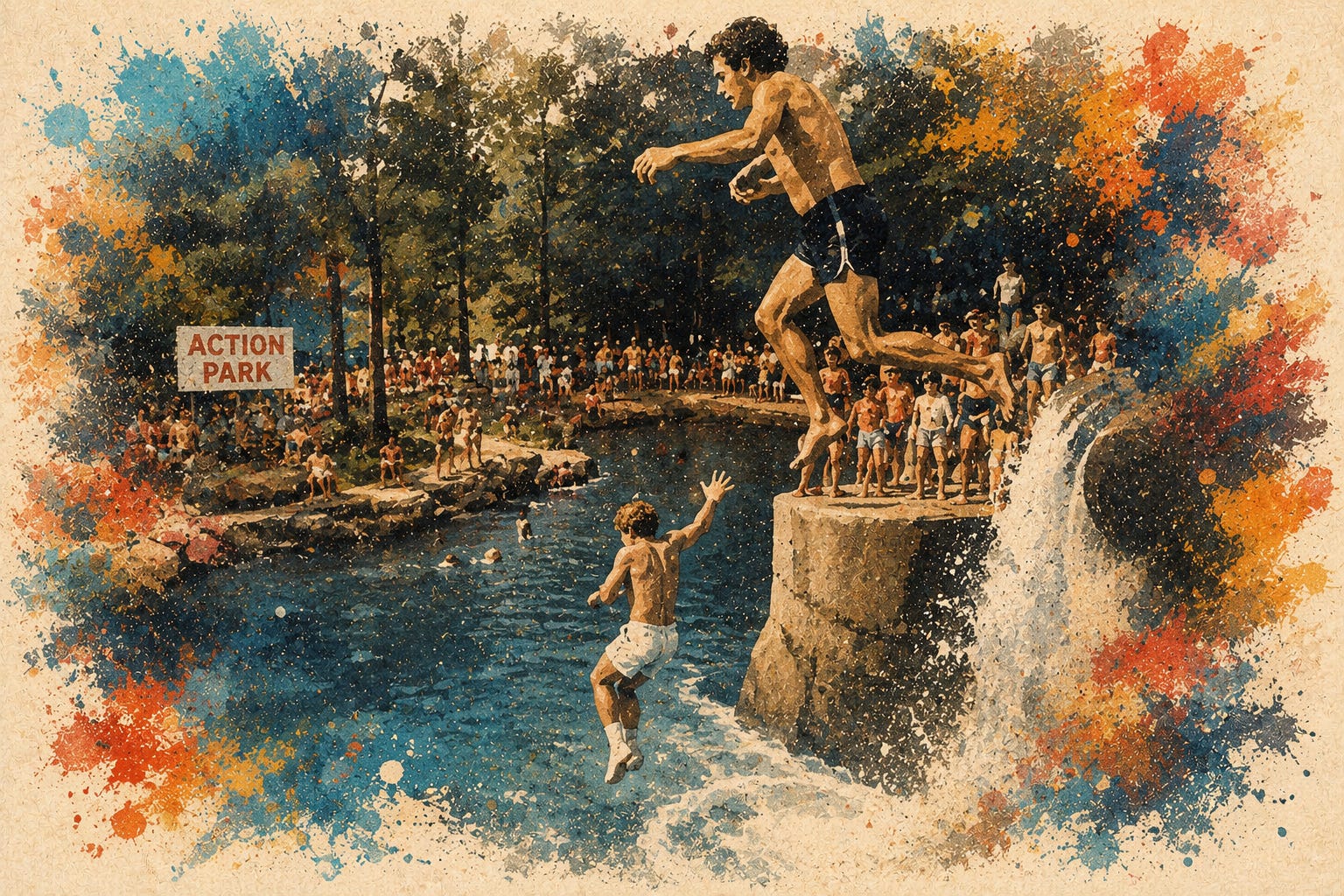
If a genie showed up today and told me I could relive any experience from my life, it would take me a millisecond to decide. And my choice wouldn’t be what you’d think. Not the night of the Iowa caucus in January 2008. Not the day I surfed Kelly Slater’s wave pool with friends on my 40th birthday. Not even the day my son was born.
(I don’t have kids; I’m just making sure you were paying attention.)
No. I’d pick a late July day in the mid-90s. That morning, my Uncle Richie pulled up in his black Corvette and leaned on the horn. “Put on your swimming trunks and grab your brother.” Richie was always up to cool shit, so I didn’t ask questions. My brother Yuri and I stacked ourselves into the one passenger seat and tore off to Nirvana Unplugged. At the foot of the Goethals Bridge, Richie turned the music down. “You ever hear of Action Park?”
Of course, we’d heard of Action Park. As far back as I could remember, their commercials were all over daytime television. But we didn’t need the commercials because Action Park had a reputation of sorts in my neighborhood. Older kids talked about it like some kind of mystical experience, a vision quest.
You might be thinking: every town has an amusement park. Why is this a story?
Well, has your amusement park been the subject of a movie and multiple documentaries, with titles like Class Action Park, The Most Dangerous Theme Park in America, and Defunctland?
What made Action Park so special and notorious? Well, it starts with the man who founded it and his particular theory of risk. That man was Gene Mulvihill, who was kind of like a cross between Walt Disney and Johnny Knoxville. His son Andy wrote a book about the park, and described Gene as someone with “no experience of any kind running an amusement operation. . . . My father pieced together a series of ambitious and often ill-advised attractions on the side of a ski mountain in rural New Jersey that he had come to own virtually by accident.”
Here’s how Andy describes his father’s creation:
Unlike most theme parks, Action Park did not strap in patrons and let them passively experience the rides. A roller coaster, thrilling as it may be, asks nothing of its occupants, and each ride is the same as the last. My father seized upon the idea that we were all tired of being coddled, of society dictating our behaviors and lecturing us on our vices. He vowed that visitors to Action Park would be the authors of their own adventures, prompting its best-known slogan: “Where you’re the center of the action!” Guests riding down an asbestos chute on a plastic cart could choose whether to adopt a leisurely pace or tear down at thirty miles per hour and risk hitting a sharp turn that would eject them into the woods. They decided when to dive off a cliff and whether to aim for open water or their friend’s head. They could listen when the attendants told them to stay in the speedboats, or they could tumble into the marsh water and risk getting bit by a snapping turtle.
The philosophy is best absorbed by comparison. Every park back then had a river-rafting ride. At nearby Six Flags Great Adventure, you were strapped into a heavy circular boat engineered never to flip, and you didn’t steer.
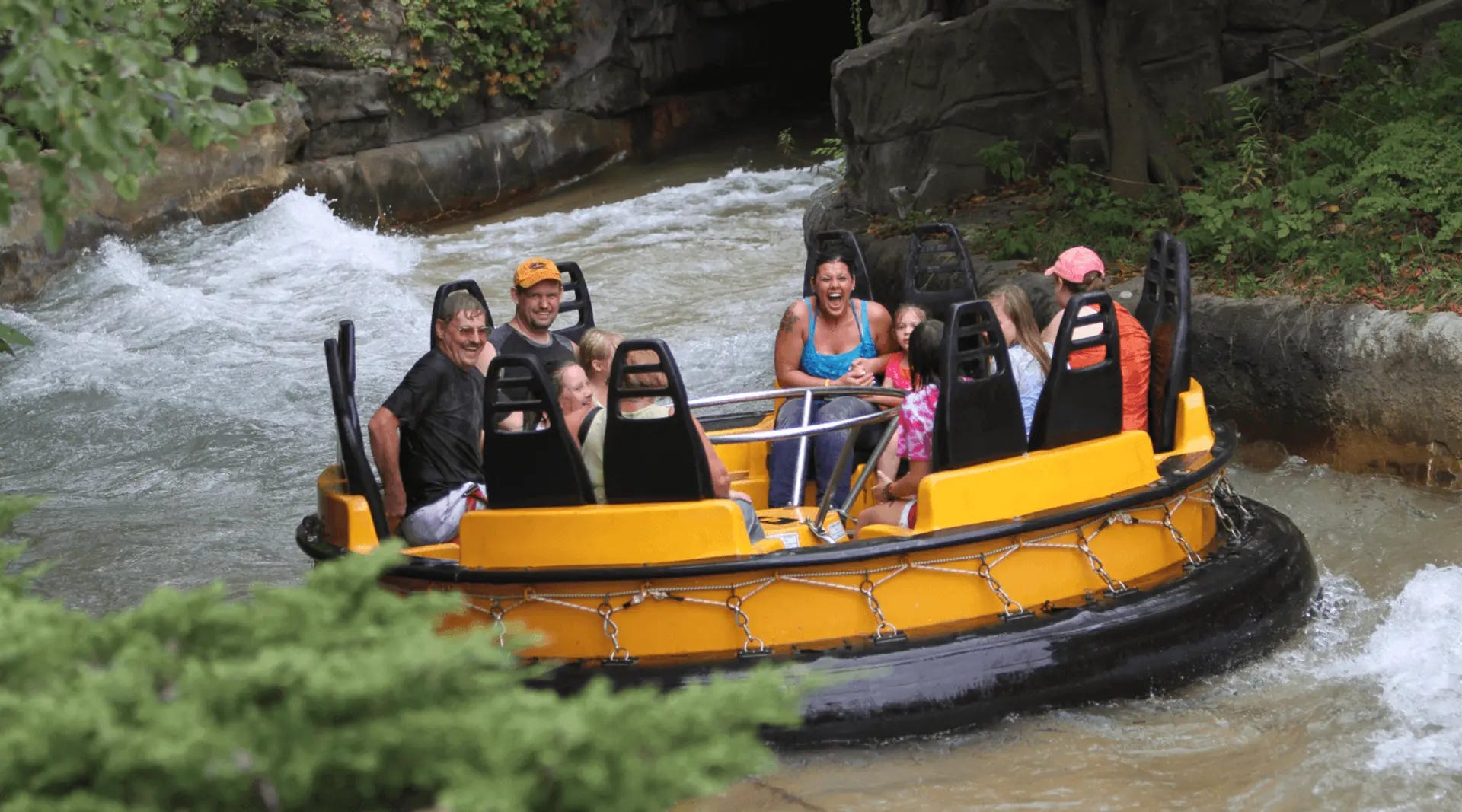
At Action Park, you grabbed a giant raft at the base of the mountain, hauled it to the top with your friends, dropped it in the water, and pointed yourselves down a steep manmade river.
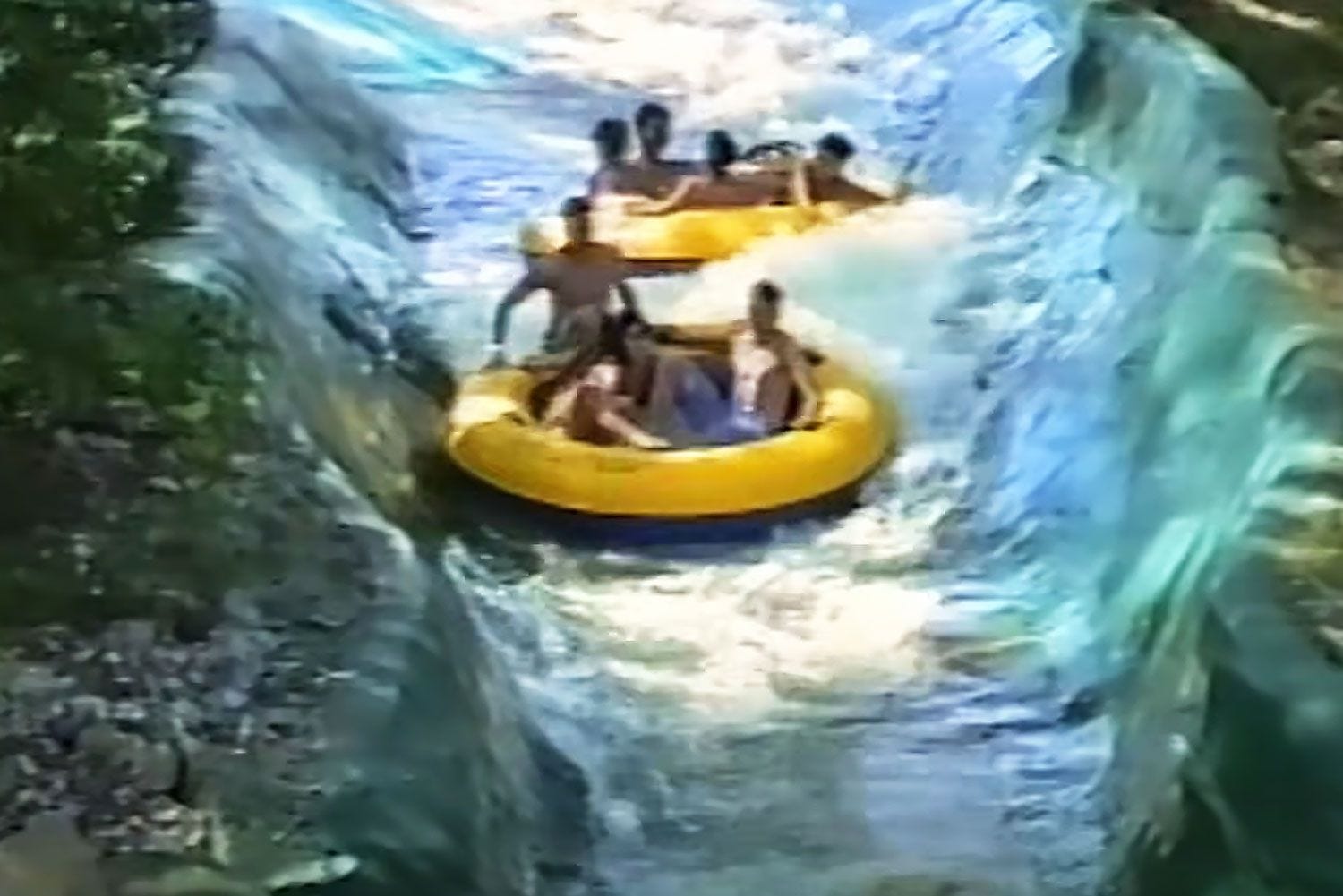
No seatbelts, and no assigned seats. On my first trip, the three of us piloted our raft into a gnarly turn and flipped the whole thing.
Action Park ran on the idea that the true fun lay in embracing agency. Take Back Control, basically, thirty years before Dominic Cummings. A Tarzan Swing that was a rope and a cold body of water. An Alpine Slide, where you rode a plastic cart with an actual accelerator down a ski slope. A cliff jump. A wave pool that I remember as pure chaos.
Every ride was a dare you either took or didn’t. That first day, I skipped the Tarzan Swing, the cliff jump, and the steepest slide, a hundred-foot drop notorious for ripping people’s bathing suits clean off. Each time I came back, I knocked one or two more off the list, usually after sustained peer pressure from older kids, or from Richie.
There was one ride we never got to try, because it had been shut down for years by the time I arrived. The Cannonball Loop.
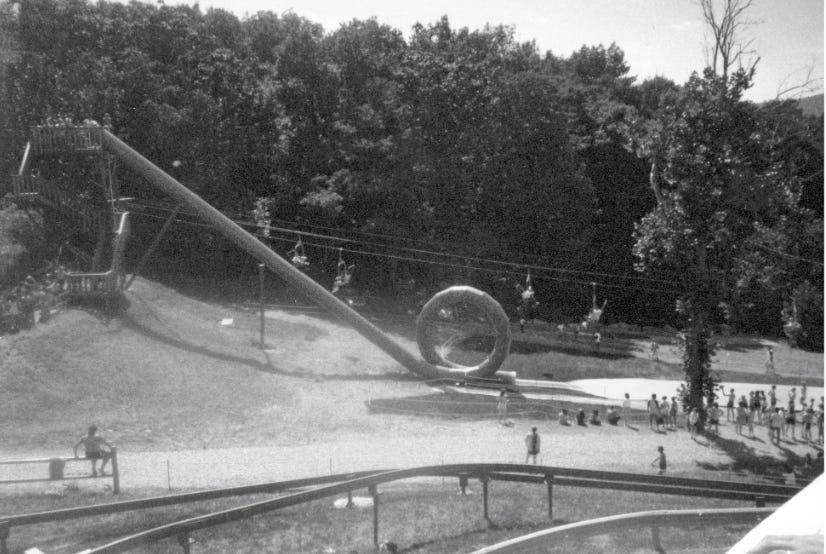
When I first visited, it was still standing, roped off. For most of my life, when I later described it to people, they assumed I was exaggerating. It was an enclosed tube slide that ended in a literal vertical loop. You’d drop down the chute, supposedly build enough speed to beat gravity, and shoot through a full 360 before splashing out the end. During its brief operating window in the 80s, it left riders with bloody noses, missing teeth, and broken bones. When someone didn’t carry enough speed to make the loop, an employee opened a trapdoor at the bottom to fish them out. Before they let a human on it, they sent a test dummy through. The dummy came out decapitated.
I interviewed Andy a few years ago and asked how they built the thing. “We found some local steel pipe and welded it together,” he said. They lined the inside with foam and vinyl and ran water through it to keep it slick. Gene liked to have his kids and their friends test the rides. Andy rode the Cannonball first, in hockey gear.
The park became a genuine phenomenon, with over a million visitors a year at its peak. It was also a magnet for controversy. Six people died there between 1978 and 1996, four of them in a three-year stretch from 1982 to 1984. Gene’s response to scrutiny was to double down. When no insurer would cover the park, he set up his own insurance company in the Cayman Islands and kept the gates open. A state investigation resulted in a 110-count indictment, and Gene eventually pleaded guilty to five insurance-fraud charges.
By the time I showed up, the park had sanded down the roughest of edges. The Cannonball was closed. The wave pool had real lifeguards. My rough estimate is that the park was still about 90% of what it had been in its prime, and that the missing 10% was exactly the 10% that needed to go. From what I gather, the last death was in 1987. What eventually did the park in wasn’t a single tragedy but the accumulated weight of lawsuits and regulatory pressure. It closed in 1996 and flickered on and off for the rest of the decade.
Here is where I have to be honest about what I’m defending, because “six people died” is a sentence that ends most arguments before they start.
So let’s look at how they died. Three of the six drowned in the wave pool. One was electrocuted by a live wire on the kayak ride. One had a heart attack after the cold shock of the Tarzan Swing. The first, in 1980, involved a teenage employee who was thrown from the Alpine Slide.
Almost none of that is the danger Gene was selling. The wave pool didn’t ask anything of you. It was just a chaotic mess. You got in the water and tried to survive. And a live wire in a simulated kayak is not an adventure. It can and should be caught by proper testing protocols and inspectors. Gene’s mistake wasn’t in his grand conception, but in how he cut corners on the boring, invisible stuff: lifeguard ratios, electrical work, the things that have nothing to do with whether you’re the author of your own adventure.
That’s the distinction that’s been lost in the debates and documentaries over Action Park. There is danger you choose and author, and there is danger done to you by negligence. The cliff jump is the first kind. The frayed wire is the second.
That’s roughly what the mid-90s version was. The rides that asked something of you could be dangerous, but we all knew the risks.
Andy has his own way of putting it. The mistake, he told me a few years ago, was calling it an amusement park at all. People arrive at an amusement park with a fixed set of expectations. He prefers “participation park.” We let people do genuinely dangerous things all the time, he pointed out, as long as we file them under the right heading. Downhill mountain biking is dangerous, he said. Put that exact course inside an amusement park, and people will protest. But anyone living in the right area can suit up and take that risk whenever they want.
That instinct, that risk is fine over here but unthinkable over there, runs through our society. We tolerate danger when it comes wrapped in privilege. Skiing, surfing, and horseback riding. Somewhere between forty and fifty people die skiing in this country every year, and we treat that as the price of a sport worth having. Nobody proposes closing our ski resorts.
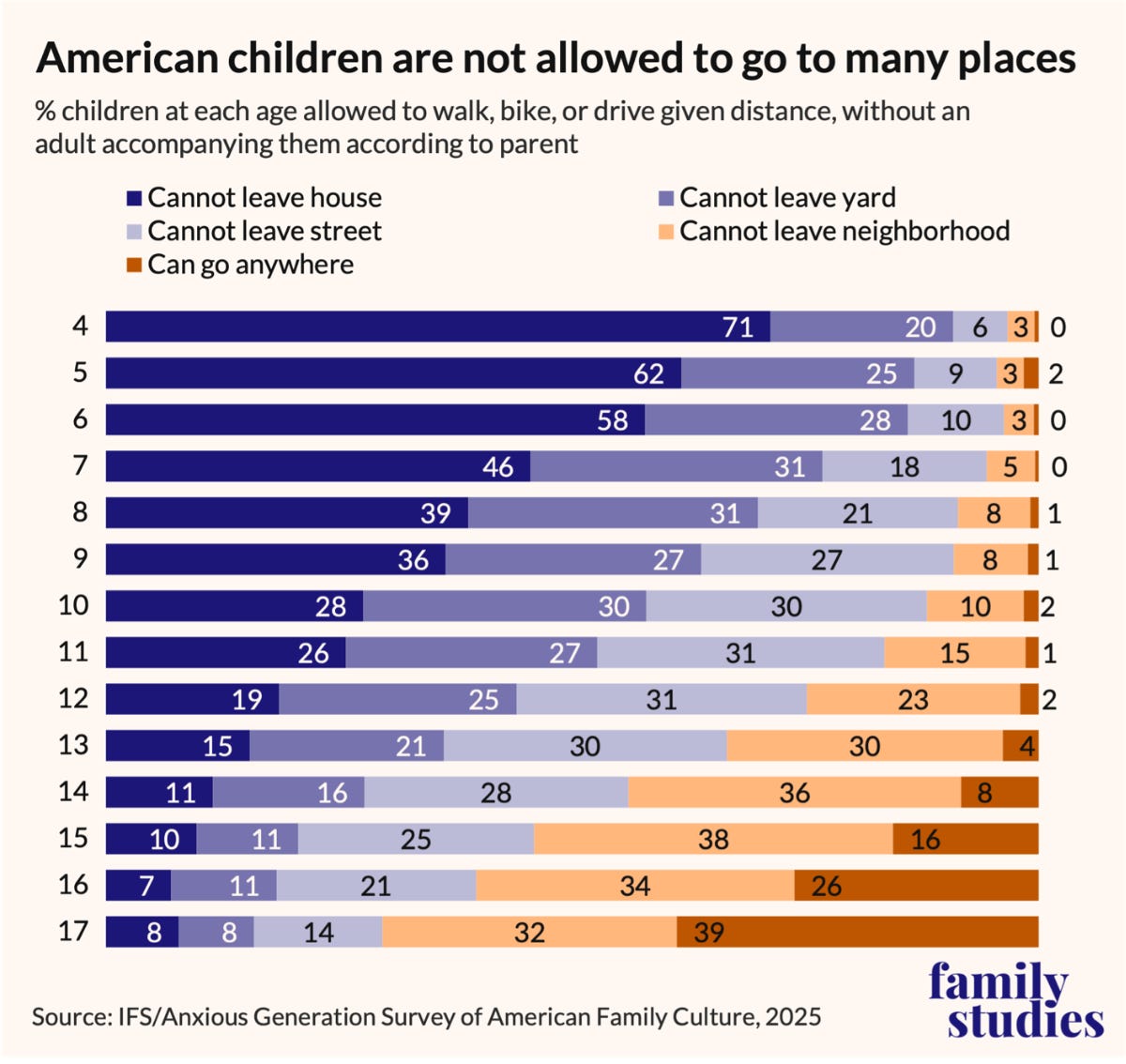
Meanwhile, the version of risk that used to be cheap and aimed at the middle class, like Action Park, is all but gone. In neighborhoods across the country, kids aren’t even accessing the kinds of risks that used to be free and ambient. A 2026 survey from the Institute for Family Studies found that even at seventeen, about sixty percent of American kids still aren’t allowed to leave their own neighborhood unsupervised. Seventeen.
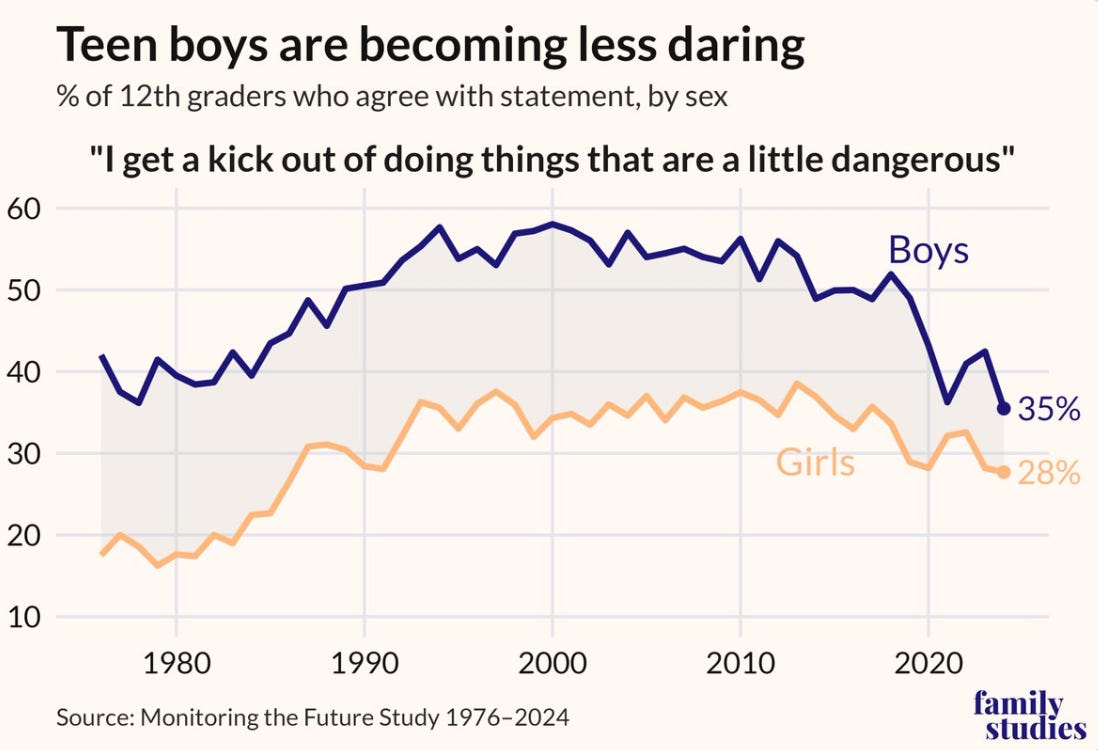
And starting with the pandemic, teens (especially boys) are much less likely to do anything daring.
Jonathan Haidt and my friend Lenore Skenazy have spent the better part of a decade pointing out the dangers of bubble-wrapping our kids. They argue that our kids are becoming too fragile. An immune system kept in a sterile room becomes vulnerable to even the weakest pathogen. The same goes for the psychological system: deny a kid stress, conflict, and risk, and you produce an adult who never built the machinery to cope with life. Helen Keller, who had more standing than most to weigh safety against living, put it in twelve words. “Avoiding danger is no safer in the long run than outright exposure.”
And, if we are being honest, beyond the developmental reasons, there’s another reason why places like Action Park have value: they are fun. And sometimes that’s all the rationale we need. Not every childhood experience needs to be justified on educational terms.
It may be strange for a former educator to come out in favor of danger. But here I am.
And let me layer in a narrow request and a broad one to help bring this home.
The narrow request is to bring back the actual Action Park. The mid-90s version had it about right. When I asked Andy what else he’d change, we landed on solutions like a better-trained staff and an honest, thorough pre-brief, a moment where every guest is told plainly what each ride can do to them before they choose it. Informed consent, basically. You keep the cliff jump. You just make sure the water is a safe temperature and the person jumping has been told the basic parameters.
The broad request is to bring back the Action Park mentality. We need to get goofier, more adventurous, more willing to let ourselves and our kids absorb some risk on purpose. For the purposes of growth and resilience, but also for the hell of it.
Bring back unpadded tackle football in the snow. Bring back climbing trees. Bring back getting lost on a long bike ride through a neighborhood you don’t know.
And bring back the rites of passage set by peers rather than adults. Where I grew up, there was an abandoned hospital in the woods, and getting through it was the test. You walked a pitch-black tunnel, crossed a burnt-out floor, scaled a wall, and came back with a straitjacket from the old psych ward to prove you’d made it. Some of it is needlessly risky, but we are so far from that world now that I’m not losing any sleep over the danger of overcorrecting.
(Written by a human, edited with Anthropic)
Watches/Listens
Texas Senate Deep Dive
I analyzed the strengths and weaknesses of Talarico and Paxton — and what either needs to do to win. (Youtube)
How to Make the Perfect Neapolitan Pizza
I give a step-by-step explanation for how to make a perfect pizza with lessons drawn from the Neapolitan masters. (Youtube)
The $40 Billion Money Pit
I interviewed Atlantic writer Marc Novicoff about the incredibly expensive and surprisingly mediocre NYC school system. (Youtube) (Podcast)
Texas Senate, Iran, Trump Corruption, Redistricting
On Majority 54, Jason Kander and I tackled the news of the week. (Youtube) (Podcast)
Jesus Christ that wave pool - I don’t know how I made it out alive.
I loved this place in the mid 90s and vividly remember the roped off cannonball, the frigid Tarzan swing (back then I was so short someone had to lift me up to reach the handle bar and somehow my parents were ok with letting me swing)... and of course that cliff jump. I think all the time about my free range and danger filled childhood vs the more careful approach I now think is normative for my own kids. For the record, there is no way I would let me 9 year old try the Tarzan swing... but I very much support reintroducing the mentality in a more thoughtful way.