
Go to Camp
On pizza school, immersive learning, and the serious inside the trivial

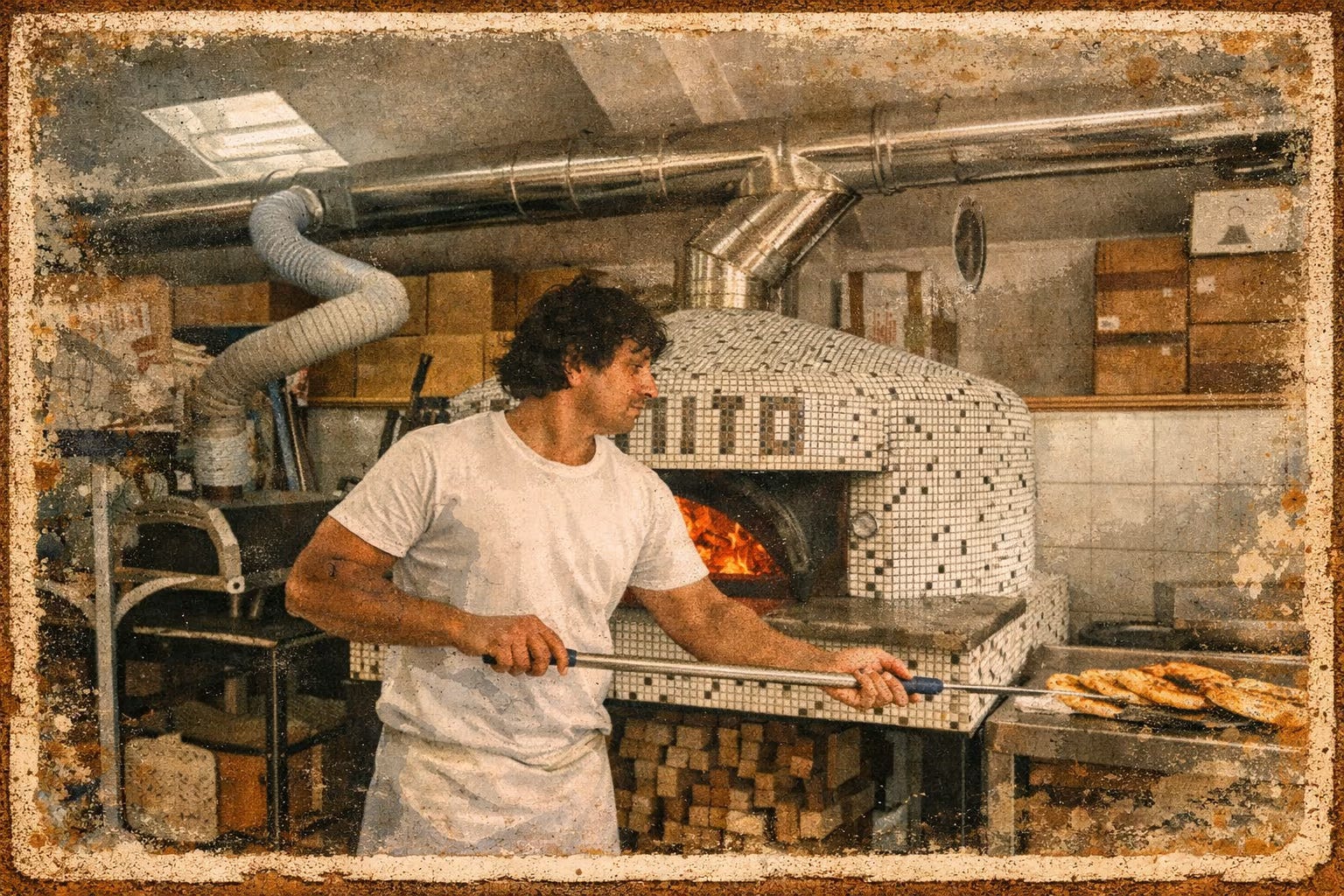
Before I left for Naples, I told my friend Jamie’s four-year-old daughter Vivi I was going to pizza school.
She looked at me like I’d said something obvious. Of course you are.
To a four-year-old, what adult wouldn’t want to go to pizza school? What else would you do?
Most of my adult friends were more skeptical. Not mean about it. Just — a pause. A smile. Pizza school. The tone you’d use for something charming but goofy.
They’d clearly never met the folks at the Associazione Verace Pizza Napoletana (AVPN). They are the governing body of true Neapolitan pizza, founded in 1984 to protect and certify the real thing. There are only a few hundred certified pizzerias in the world. The AVPN sets the standards: which flour, which tomatoes, which mozzarella, how hot the oven must run, how long the dough must proof. It is, in its own way, as rigorous as any culinary institution on earth.
Umberto Mauriello, our instructor, was a certified AVPN master and a decorated competitor — silver medalist at the Olimpiadi della Vera Pizza Napoletana in the most prestigious category, the Specialità Traditionale Garantita, which judges dough consistency, topping quality, and wood-fired technique against hundreds of masters from dozens of countries.
I attended the AVPN school with my friend Mike Simon, who moved his family from Brooklyn to Madrid for two years and is a serious home cook — usually the one running the kitchen on Sunday dinners. I am less serious. Significantly better than I was before my Lucca excursion in the fall, but still basically novice.
The rest of the class were experts looking to level up to elite. Most of them either owned a restaurant or were in the process of opening one. Our particular cohort included a Belgian pizza chef who runs what is probably the best pizzeria in Belgium (4.9 on Yelp; he insists the missing .1 is from a customer he turned away because they were full), a Romanian kebab and food truck entrepreneur, a Slovenian casino owner and restaurateur, and a handful of others I would not have encountered in any other context in my life.
More on them in a moment.
At the AVPN school, we make about 30-40 pizzas a day each, from 10am to 7pm with a very short break for lunch. A very un-Italian schedule.
On day one, our teacher Umberto handed us a ball of dough and told us to start pressing.
No sauce. No cheese. No pizza. Just dough.
Day two: shaping. How to take that ball and open it into a disc without a rolling pin, without tearing it, without losing the air pockets that make the crust what it is.
Day three: red pies. Tomato, olive oil, garlic, oregano.
Finally, on day four, we were allowed to use cheese.
It sounds almost insultingly slow. We’re adults. We paid to be here. Give us a real pizza.
But when we finally made a proper Margherita, every one of us understood exactly what we were doing and why. Umberto had engineered our progression so that each session built on the last, each challenge arriving exactly when we were ready for it.
What Only Camp Can Do
I’ve been doing these immersive learning experiences — a fancy way of describing adult camps— for the better part of a decade.
Power Monkey Camp, twice (weightlifting and gymnastics). That’s where I met Sadie Durante, my Squadra co-founder and now a close friend.
Total Tennis Camp in Saugerties, New York, five times. I’ve made lifelong friends there too (looking at you, Ana and Keith).
Surf Simply where I met Tommy Potterton, who’ve I’ve since surfed with hundreds of times, including all the way out in Sri Lanka.
I could go on. The Mouratoglou and Nadal tennis academies. The cooking school in Lucca, which ran two months.
Some solo. Some with friends. Some days, some weeks, some months.
I am not a professional athlete. I’m not aware of many non-professional adults who’ve done as many of these as I have. And I’ve thought a lot about what makes them different from every other way we try to learn things.
Here’s the core of it: whenever I take an ongoing class — weekly lessons, monthly workshops, anything with gaps between sessions — there’s a cost. Every time I come back, I spend the first portion of the session reminding myself where I left off. Warming up the mental muscles. Reconstructing the context. That’s a tax on learning.
In two weeks in Naples, I did sixty hours of pizza training. At the more traditional one hour per week pace, that would have been more than a year of lessons. But it’s not just the quantity. There was no learning leakage. Each morning I picked up exactly where I left off the afternoon before. The knowledge compounded instead of evaporating.
Psychologists have a term for what’s actually happening here: situated cognition. The idea is that learning cannot be fully separated from the context in which it happens. Knowledge lives in the activity, the environment, the physical and social reality around you. This is why you can read ten books about surfing and still wipe out on your first wave. The body has to learn where the mind cannot. And the less stuff you put in between learning sessions, the more your body and mind begin to adapt.
The progression Umberto built — dough, then shaping, then sauce, then cheese — was doing something specific. It was matching the challenge to our growing skill level at exactly the right pace. Not so easy we coasted. Not so hard we shut down.
Sports science researchers at Texas A&M have studied this in camp environments and found that when activity difficulty is progressively matched to a learner’s growing skills, three psychological needs are satisfied simultaneously: autonomy (you’re doing, not watching), competence (you can feel yourself improving), and relatedness (you’re doing it alongside people who are in the same struggle). That cluster reaction is what produces full immersion. What Csikszentmihalyi called flow. Students in flow states show 30% higher task persistence and deeper learning than those outside it.
The data on camps bears this out. Learners in immersive language programs achieve 40% faster proficiency than classroom-only students. Randomized controlled trials in clinical training show up to 38% reduction in overall training time — and skills acquired in immersive settings decay more slowly. A 2023 Harvard Business School study of 50 professionals on sabbatical found that the ones who moved through recovery, exploration, and active practice (not just a standard rest and reset vacay) were the ones whose self-narrative fundamentally changed.
The Thursday Morning Test
The benefits of immersive experiences go beyond the skill. They are the best way to meet and connect with new people.
I’ve been to conferences. I’ve done the bonding exercises. I’ve done the shared reflections, the group dinners organized by someone’s assistant. Good experiences. Real connections, even.
But nothing like a camp.
In Naples, at first it seemed as if our phones would pollute the experience. For the first three days, when we arrived each morning, everyone found a seat and immediately pulled out their phones. Professional strangers in a foreign kitchen. Polite. Slightly competitive. Guarded.
Then Thursday happened.
I noticed it when I walked in. Nobody had their phone out. Everyone was already talking, laughing, leaning in. The Belgian pizza chef was showing the Romanian pictures of his restaurant. Mike had somehow become friends with the Slovenian. The Indian student was telling me about her plans to go back to Gujarat to teach kids to make pizza.
I’ve done this enough times to recognize that moment. It usually arrives on the third or fourth day. You can’t manufacture it with ice breakers. You can’t schedule it. It just comes — and when it does, everything shifts. Everything gets deeper and more fun.
By the end of the second week, we’d been to dinner together, made fun of each other’s technique, and gotten deep into each other’s lives in the way you only do when you’re tired and covered in flour and far from home. One person got a Dear John letter mid-week. Another had a manic episode and had to check himself into a hospital.
Everyone rallied. No hesitation, no awkwardness, no one quietly stepping back. Just — of course. What else would you do?
That earnestness is what Vivi still has. What most of us lose somewhere along the way. What these people had somehow held onto, or found again, in a Neapolitan kitchen.
We promised to visit each other’s countries. I’m already looking forward to it in a way that feels almost embarrassingly specific: the best pizzeria in Belgium, Bucharest, Ljubljana. It adds to a list I started in Lucca -- plans to visit those classmates in their placement restaurants this summer. This is one of the stranger and more wonderful side effects of doing these things repeatedly. The world gets smaller and better at the same time.
A Different Kind of Hard
I thought I was in shape. But I learned it’s not on-your-feet-doing-manual-labor-for-nine-hours-in-a-Neapolitan-kitchen shape, which it turns out is a completely different category of fitness than my powerlifting and tennis built. By day three my lower back hurt like it had never before. By day five my feet were swollen Knowledge workers, take note: the body you have built for sitting in chairs and occasionally lifting things is not the body you need here.
I also learned — again, as I relearn it every time — how clarifying it is to be a beginner around people who are serious. Our cohort weren’t hobbyists dabbling on weekends. They had real money, real reputations, and real livelihoods riding on getting this right. That energy is contagious in a way that’s hard to describe and impossible to fake. It raises your own ceiling without anyone saying a word about it. You just find yourself working harder, staying later, asking Umberto one more question before he leaves the kitchen.
Being the least accomplished person in the room is deeply underrated.
I’m apparently not alone in loving this.
Yelp reported a 347% increase in searches for adult camps heading into 2025. Fitness retreats up 83%. Wellness retreats up 58%. A European adult camp called Camp Château sold out every spot within five days of launching — 11,000 people on the waiting list. Adults aged 30–65 are now the fastest-growing demographic in educational travel.
Some of what’s driving this is nostalgia. Some of it is burnout. Some of it is the creeping awareness that if we’re learning anything at all these days, it’s in front of a screen — and that kind of learning has its limits. People are hungry to get good at something again. Something physical, something real, something you can only learn with your hands and other people around you.
Not all immersive experiences are the same, and it’s worth being specific. Some are a weekend, some are months. Some are more retreat-style — wellness, reflection, disconnection — which is fine, but not what I’m talking about. What I’m pointing you toward are the ones built around a craft: a sport, a culinary tradition, a physical practice. Something with a standard of excellence that existed before you arrived and will exist after you leave. Something you can actually get better at.
And the barrier is lower than you think. Total Tennis Camp in Saugerties is a weekend, welcomes kids, and costs less than a decent hotel stay. Surf Simply has options across price points. The AVPN school in Naples is two weeks, but you could start with a long weekend at a cooking school an hour from wherever you live. You don’t need to go to Naples. You just need to go somewhere.
The Trivial is Serious
Here’s what a decade of doing these has taught me: the things that look trivial from the outside are almost never trivial on the inside.
Every craft, looked at closely, is an abyss. The closer you get, the deeper it goes. Umberto has devoted his life to a dish whose recipe fits on an index card. That sounds like a punchline. It isn’t. The distance between a forgettable pizza and a transcendent one runs through water pH, through fermentation temperature, through the angle of your wrist when you open the dough, through ninety seconds in a 900-degree oven. Mastery hides inside what looks like simplicity.
Tina Brown once said she wanted to make the serious sexy and the sexy serious. I’ve been doing something adjacent: learning to find the serious inside what everyone else has already decided is trivial. It’s there. It's always there. You just have to get close enough to see it.
Camp is the fastest way in.
Delizioso, Ravi! Your piece-za got me asking various questions.
1. What's your dream camp topic? Sounds like it's gotta be hands-on. I think a massage camp w my wife would be great (we did private sessions 6 years ago and still benefit; would be even fun(nier) with other couples around)
2. Could this intensive camp structure be applied more for our kids education in the place of the many-classes-in-parallel approach?
3. What's the meta skill you're honing across these camps? And not just "learning to learn," because I suspect it's deeper than that and tied to your actual profession/superpower.
PMC is the best!