
The 50/50 Life
Most of us can't go off the grid. But we can go half.

The average American spends over seven hours a day looking at screens. That’s roughly 40% of our waking hours. And that doesn’t include work-related computer time, which pushes many of us well past 50%. Gen Z averages nine. Teenagers clock north of eight, most of it on entertainment.
Let me put this differently, because I think we’ve become numb to the statistics.
You will spend more of your life staring at your phone than you will spend eating meals with people you love. More time than you will spend playing with your kids. You will, on average, check your phone 96 times today—which means that in the time it takes you to read this essay, you will feel the urge to check your phone at least twice, and I am choosing not to take that personally. If you got your first smartphone at twelve and live to seventy-six, you will spend roughly twelve years of your life on your phone. Twelve years. You could learn Mandarin. You could get a medical degree and a law degree, and still have time to sue yourself for malpractice and appeal it all the way to the Supreme Court.
We now spend more time on screens than we do sleeping. This is the water we swim in. We’ve normalized something that, viewed from any historical or biological perspective, is profoundly abnormal.
In my last post, I made the case for a radical break from this digital dystopia. From the tech companies and their tools of distraction—platforms engineered to hijack our attention and monetize our anxiety. I called it a new kind of movement, rooted in Gandhi’s ethics of sacrifice and self-sufficiency.
Some of you wrote to say you were inspired. Others wrote to say you want to buy into this approach but have too many digital obligations.
Fair enough. If you can pull off a Paul Kingsnorth-style retreat—off the grid, growing your own food, writing by candlelight in rural Ireland—more power to you. That path has a certain purity to it.
But most of you have careers that require you to be online quite a bit. You can’t disappear into the woods. You need your laptop. You need your email. You may even need to post on social media for work.
For you, I want to propose something more practical: the 50/50 life. Devote half your waking hours to analog living.
What Counts as Analog
During your analog hours, you commit to: no smartphone, no screens with internet access, no podcasts or streaming music.
What you keep: physical books, longhand writing, exercise without a phone, vinyl records, board games, face-to-face conversation, cooking, gardening, walking, surfing, running. Anything that doesn’t require a glowing rectangle.
If you’re awake for sixteen hours, that means eight hours of analog time per day. If that sounds radical, remember: this was simply called “life” for most of human history.
For the other 50%, you can be maximalist. Use every tool at your disposal. Be on the vanguard of AI. Leverage the tech ruthlessly. The point isn’t to reject technology. It’s to contain it.
How to Structure It
If you don’t control your work environment—if your job requires you to be online all day—then you’ll need to be ruthless about your non-work hours. Phones away when you get home. Screens off on weekends (when you can “make up” for any deficits you’ve accrued during the week). Mornings or evenings protected as analog sanctuaries.
If you do control your schedule, I suggest splitting your workday itself. I spend mornings analog: writing longhand, typing without internet, thinking without input. Then in the afternoon, I switch. Email, calls, AI tools, research. All of it concentrated into a focused block.
I’ve argued before that schools should adopt this approach. No screens for half the day. Kids learn to read long texts, debate ideas, reason from first principles, sit with boredom. Then they spend the other half mastering the tools. You graduate students who can think deeply and use technology effectively. Not kids who can do neither.
I suspect many non-education institutions could adopt this split. Law firms where the mornings are for in-person client meetings, reading printed out cases, mapping out strategy on yellow pads, or brief writing without the internet. And afternoons for research databases and client calls. Newsrooms where reporters do their source work in person and their filing in focused digital blocks — the irony of modern journalism being that the people whose job is to observe the world now do most of their observing through a browser tab. Architecture studios where the interesting ideas start on trace paper before anyone opens CAD.
The Instrumental Case
There are intrinsic reasons to spend less time on screens. Presence. Calm. Connection. Health. These are the most important benefits.
But even if you take a purely instrumental view . . . if all you care about is career performance, the 50/50 split will serve you.
The time you spend off the tech makes you better at the tech. You return with original thinking. First-principles clarity. A longer attention span. Stronger powers of organization, outlining, and synthesis. And when you do sit down at the computer, you treat that time with more focus, efficiency, and respect.
The most creative, effective people I know already live something like this, even if they don’t call it by a name. They protect their mornings. They take long walks without earbuds. They read physical books. They work out their ideas on a whiteboard. They’ve figured out, often through painful trial and error, that the quality of their output depends on the quality of their attention.
The Moves
To make this work, you may need to make some radical changes.
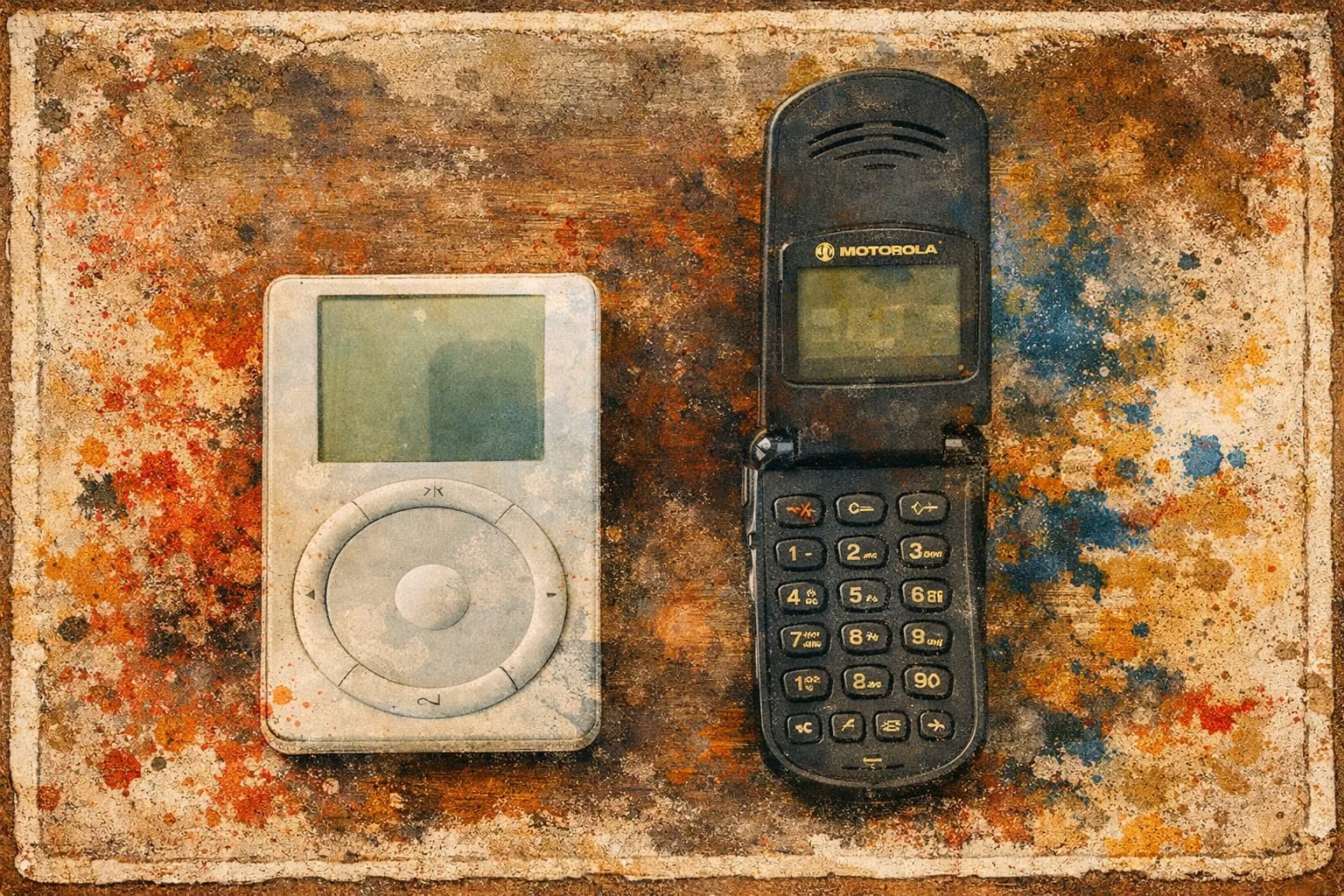
I’ve switched to a flip phone—a Cat S22 Flip. It makes calls and sends texts (slowly). It does not beckon me to scroll. I kept my iPhone for WiFi use at home, mostly for specialized apps and two-factor authentication. I bought a refurbished iPod for music.
You don’t have to do what I did. But you have to do something. The hardest part won’t be changing your own habits. It will be getting the people in your life on board — your partner, your kids, your colleagues. But you have to lead the way. Because chances are, they are every bit as caught up in the web as you are. They’re waiting for someone to go first.
The tech companies have made a bet about you. They have bet that your attention is a resource to be extracted — that you will trade your hours, your presence, your interior life for a never-ending stream of content you won’t remember tomorrow. They are betting you won’t fight back.
The 50/50 life is the fight. Not a retreat to the woods. Not a rejection of the modern world. Just a plain, stubborn insistence that half your life belongs to you.
I’m a big fan of having time away from technology. The idea of a secular sabbath always appeals to me.
I do wonder if there is a way to limit the technology only to be used when needed. There are a few apps that are really useful like Google Maps, uber, Surfline.
This is why I’ve been using a Brick recently which allows me to lock myself out of most apps besides the few ones I need to get around. I think the goal of technology free time is still correct, but I think this half measure may be an easier starting point for most folks.
Thanks for the great post Ravi!
This is gold (and I printed it to have my 8 year old read it).
My favorite analog creative things to do with my kids: (1) story board (stick figures and text) and then put on a play in the living room; and (2) two nights a week we don’t read books - I tell a bed time story that is completely improvisation (from my head). I just go into it with this framework “what point do I want to carry - or - is this just a wild story?” Then each night is 2 chapters of the story until it ends naturally.
When my kids are older, I’m turning the keys over to them on #2.
Just wanted to share a couple of my favorites in analog life.